From assemblies to action
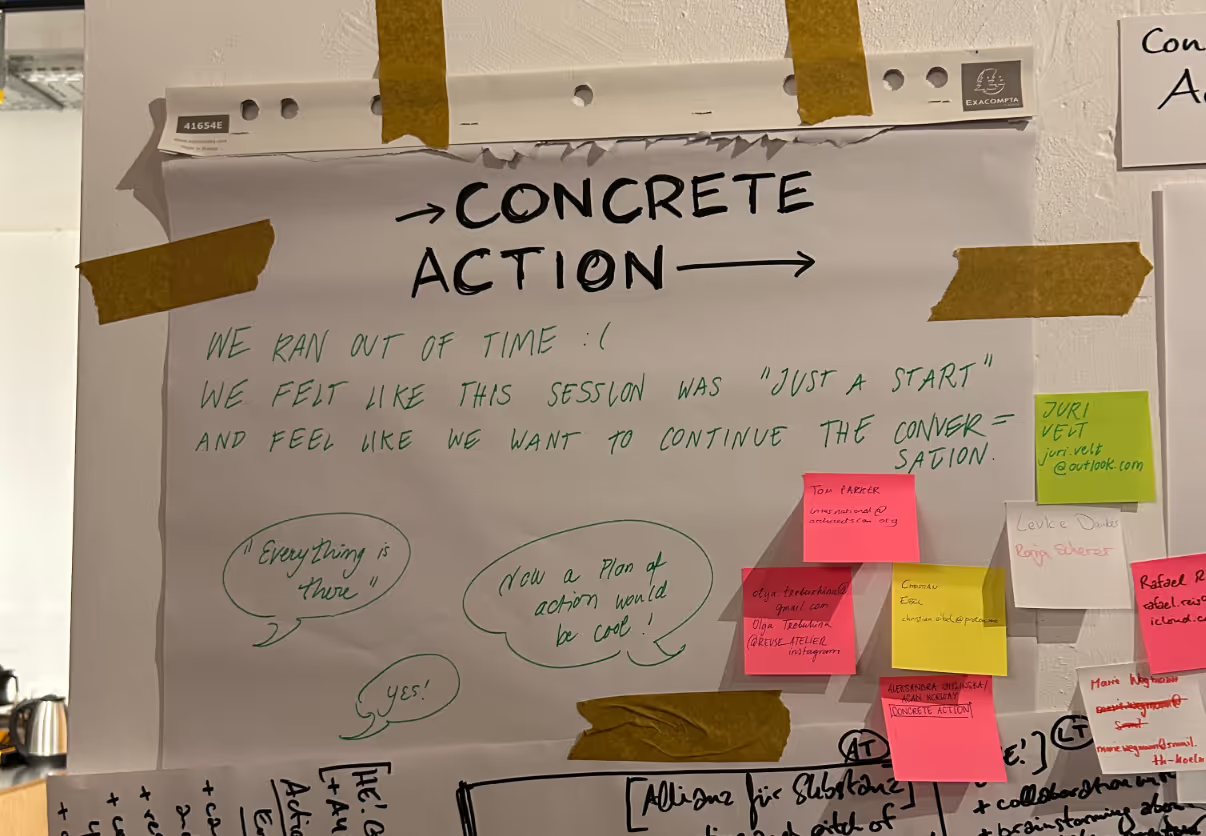
1. CONCRETE ACTION: FROM IDEAS TO PRACTICE
Across the sessions, there was a strong shared sense that action needs structure, continuity and visibility. Participants discussed different formats and scales of action, ranging from local interventions to coordinated European moments.
Recurring ideas included:
- Action cycles rather than one-off events (e.g. recurring action days or thematic action weeks)
- Combining storytelling, visual tools and physical presence (stickers, flyers, interventions in buildings, exhibitions)
- Actions that are easy to join, adaptable to different local contexts, and not dependent on large resources
- Using moments of disruption strategically, while also valuing slow, relational work
- Understanding action as a learning process: attempt is success
- shared tools (templates, narratives, visual materials) that local groups can adapt and reuse
2. POLITICAL DIRECTION: COMMON GROUND WITHOUT OVERSIMPLIFYING
In the Political Direction labs, participants revisited the core themes discussed in the first Assembly and explored whether a shared political statement or demand makes sense at this stage.
Key points of convergence included:
- Housing as a right, not a commodity
- Safety, affordability, health and long-term habitability
- Moving beyond growth and extractive logics
- Regenerative and adaptive approaches over demolition and speculation
- Transparency around ownership, power and decision-making
At the same time, participants expressed caution:
- A common statement should not flatten differences or local struggles
- It should avoid being overly technical or diluted
- Positive, accessible language was seen as crucial to reach beyond activist and professional bubbles
- a collective European statement, while keeping the process open, iterative and representative.
3. MOVEMENT BUILDING: HOW WE STAY CONNECTED
A large part of the discussions focused on how to sustain collaboration beyond the Assembly. Participants emphasised that networks do not survive on shared values alone, but need care, coordination and practical infrastructures.
Frequently mentioned needs were:
- Regular in-person meetings (1–2 times per year)
- A shared platform or map for skill-sharing and mutual support
(Who is doing what? Who can offer what? In which context?) - Knowledge-sharing formats (fundraising skills, advocacy strategies, legal tools)
- Common calendars, directories and contact points
- Dedicated coordination capacity
- Sub-granting or joint fundraising approaches
- Creating reasons to meet: concrete projects, deadlines, shared actions
Importantly, participants stressed that having fun, building trust and emotional motivation are not secondary, but central to long-term movement building.
WHAT EMERGED OVERALL
Rather than one single outcome, the Assembly clarified a shared understanding:
- Diversity of struggles is a strength – coordination should support, not homogenise
- Action, political positioning and movement-building are deeply connected
- The European level can add value by connecting, amplifying, and resourcing existing work
The Assembly was widely described as a starting point for deeper collaboration, with strong interest in continuing the process through working groups, shared tools and future European Assemblies.
Join the European Network!
- Stay informed
- Get involved in upcomin activities
- Join the info channel
- Join the working groups
- Get access to our internal platform
- Share skills
Feel free to get in touch via network@architects4future.de
Unsere
Tätigkeits-Schwerpunkte
Unsere Tätigkeiten lassen sich in drei Kategorien einteilen. Dabei ist es nicht relevant, was gemacht wird. Unsere Aktivitäten betreffen immer die Kategorie Öffentlichkeitsarbeit, Netzwerk oder Wissen.
Öffentlichkeitsarbeit
Um einen nachhaltigen Wandel in der Baubranche voranzutreiben, tragen wir unsere Forderungen mit unterschiedlichen Medien sowie auf diversen Veranstaltungen und in Kooperationsarbeit mit Organisationen und Institutionen nach außen.
Diskurs und Kommunikation innerhalb als auch außerhalb unserer Branche sind wesentliche Aspekte, um auf die Defizite und Potentiale für einen Wandel aufmerksam zu machen.
Wir erarbeiten hierfür auch konstruktive Forderungen an Politik und Wirtschaft, um existierende Hürden aus dem Weg zu räumen und Weichen für eine ganzheitlich zukunftsfähige (Bau-)Planung zu stellen.
Netzwerk
Architects 4 Future bietet die Möglichkeit, sich intern deutschlandweit mit den unterschiedlichsten Menschen verschiedener Spezialisierungsgebiete zu vernetzen.
Außerdem bringen wir andere Organisationen und Akteur:innen zusammen, damit sie sich gegenseitig unterstützen, und mit ihren Erfahrungen und Lösungen zur Bauwende beitragen können.
Wissen
Wir zeigen für die breite Masse die Relevanz und das Potential der Baubranche auf und hinterfragen dabei veraltete Standards.
Dabei möchten wir die Gesellschaft, Hochschulen und Professionelle der Baubranche darin unterstützen, zügig neue Wege zu gehen, und eine Wissensgrundlage für nachhaltige Planung aufbauen.

Section 50%

Der A4F Newsletter erscheint alle 4 Wochen.